Article originally posted by Martin Jendrischik in German on www.cleanthinking.de
Security of supply, competitive heat costs, decarbonization: These three factors determine whether an industrial company invests in a new heat storage system today. Kyoto Group’s Heatcube addresses them with a liquid-salt system that supplies process steam, reduces energy costs, and simultaneously functions as a balancing power resource.
Until about five years ago, security of supply was a given for most industrial companies. Gas flowed reliably and affordably through the pipes; the only open question was the environmental one: decarbonize eventually, but without rushing. That has shifted fundamentally, says Tim de Haas, Chief Commercial Officer of the Norwegian Kyoto Group, in an interview with Cleanthinking.de. The classic energy sector’s “triangle of objectives”—comprising security of supply, economic efficiency, and environmental sustainability—is now being completely redefined, he explains, because companies have long recognized the risk that gas supplies are no longer unconditionally available as a reality.
Behind this lies a structural gap that the energy transition has long overlooked. According to the Fraunhofer ISI’s analysis of the EU’s auction design for process heat, 75 percent of industrial process heat in the EU still comes from fossil fuels, while electricity accounts for just four percent. “Industrial plants typically use two-thirds of their energy as heat and only one-third as electricity,” explains de Haas. Decarbonization has electricity under control in many places; heat is just catching up.
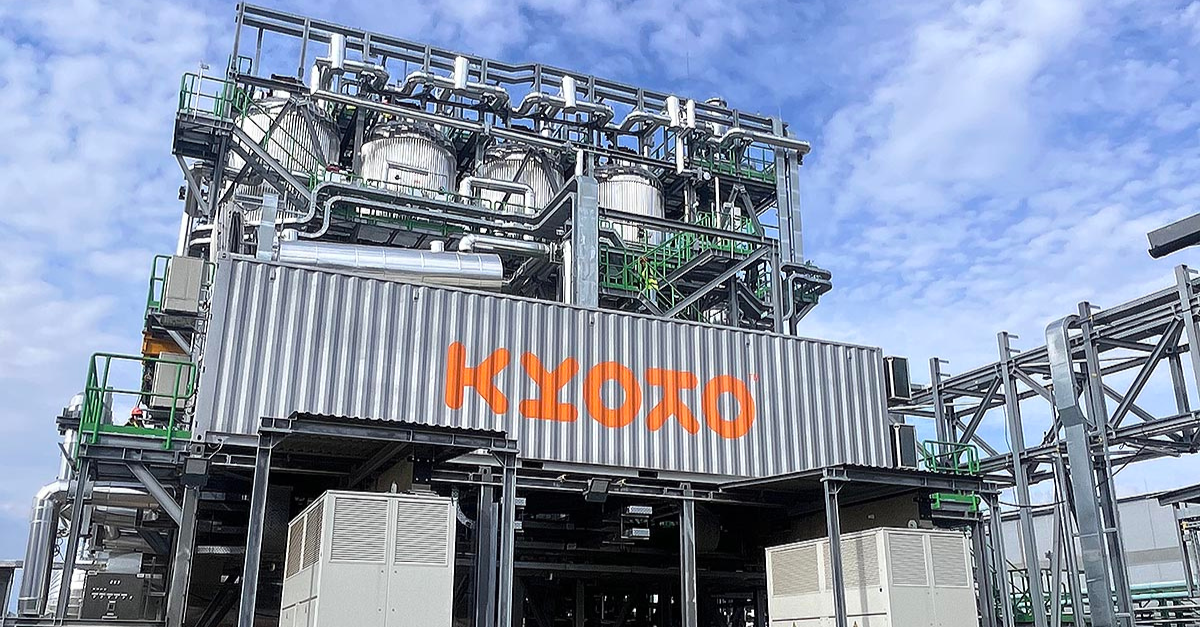
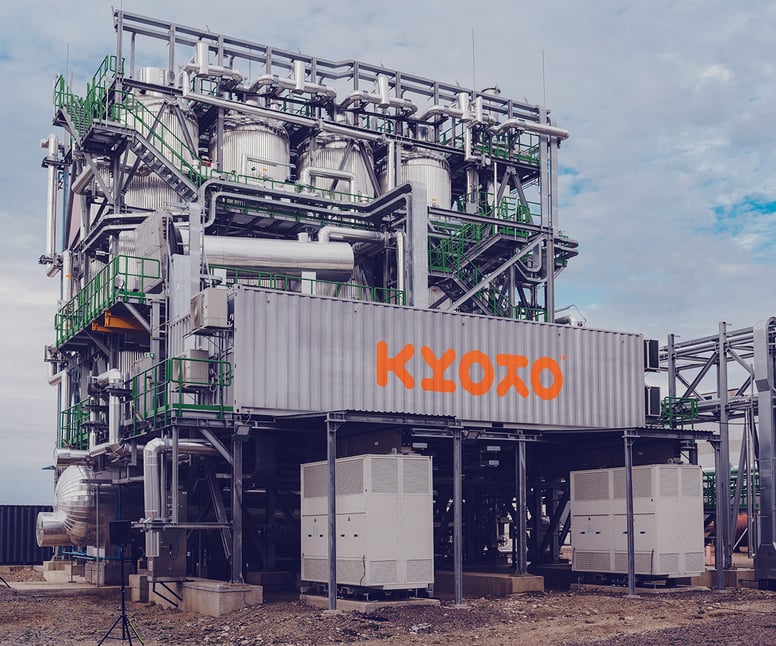
The solution from the cleantech company Kyoto Group is called Heatcube, an industrial heat storage system. The system uses molten salt heated to over 415 degrees Celsius to store energy as heat. When the facility needs steam, the molten salt releases the heat at temperatures between 150 and 300 degrees Celsius.
De Haas describes the basic principle: “We use the same medium for all three steps.” Heating, storing, transferring—the same salt, no medium exchange, no intermediate system. Because the molten salt flows, the system can charge and discharge simultaneously without interrupting the ongoing steam supply.
Hungary: The facility that is representative of the industry
Two Heatcube facilities are currently in operation, one in Denmark and one at KALL Ingredients in Hungary. According to the company, the industrial thermal storage facility in Hungary has a storage capacity of approximately 56 megawatt-hours, making it—according to de Haas—the largest electrified thermal storage facility for industrial use in Europe, significantly larger than the Danish project.
Until now, KALL Ingredients has met part of its steam demand through an existing biomass plant and the rest through natural gas. The company lacked the capital to invest in additional capacity on its own. Kyoto Group entered the project through its Heat-as-a-Service model: The company finances and operates Heatcube, while KALL Ingredients purchases only the finished steam, without making any investment of its own.
Heatcube replaces the previous gas component, while the biomass plant remains in operation. It is an example of combining technologies rather than relying on a single solution—exactly the scenario that de Haas describes as typical for the industry: “No company can claim to have the one solution for everything. Decarbonization is becoming a puzzle.”
The plant in Hungary was also the first that Kyoto Group implemented via traditional project financing, rather than solely through its own balance sheet. For a storage company that is still young, this is a milestone in its own right: project financiers now view Heatcube as a bankable infrastructure project.
According to de Haas, KALL Ingredients’ profile matches the typical target customer more closely than the Danish pilot project: industrial scale, an existing steam supply, the need for supply security, predictable heating costs, and decarbonization—without any one of these three factors taking precedence over the others.
Aalborg: the regulatory precedent
The second Kyoto plant is located at the Norbis Park port area in Aalborg, with 5 megawatts of charging capacity, 18 megawatt-hours of storage capacity, and connections to the municipal district heating network and the Danish transmission grid. De Haas describes Aalborg itself as a commercial pilot project: The project was deliberately chosen so that tests could be conducted during the summer months when demand is low, and is therefore not necessarily representative of a typical industrial customer.
Nevertheless, Aalborg remains relevant from a regulatory standpoint. According to the company, the plant saves approximately 2,000 metric tons of CO₂ per year and is the first project worldwide in which a molten salt storage system supplies steam to a municipal district heating network. Grid operator Energinet has also approved Heatcube for the DK1 balancing power market; according to the company, it is the first and only molten salt storage facility in the world to receive this approval. The plant can provide automatic frequency regulation (aFRR) and manual frequency regulation (mFRR), with a response time of less than three seconds.
This sets a precedent for the industry: A thermal industrial storage system is now recognized as a full-fledged player in the Danish balancing power market alongside battery storage systems. A facility that registers its thermal storage as a flexibility resource decouples itself from the real-time price of electricity and offers an additional service to the grid operator. De Haas: “If you need steam, store the energy in the form of heat.”
Other heat storage systems for industrial steam use solids. EnergyNest stores heat in special concrete (40 MWh at tesa in Hamburg; ground-breaking has not yet taken place), while Rondo Energy stores heat in bricks (100 MWh at Covestro in Brunsbüttel; ground-breaking scheduled for January 2026). Both approaches require a second medium—usually thermal oil or air—to transport heat in and out, because the solid material itself cannot flow.
CAPEX vs. OPEX: Where cost-effectiveness is decided
An electric boiler is cheaper to purchase than a Heatcube—that’s undisputed. If you look only at the upfront costs, you’ll almost automatically choose the electric boiler. But focusing solely on CAPEX overlooks how the system performs during operation: An electric boiler without a storage tank is directly exposed to the spot market price for electricity at all times, with no way to avoid peak-hour rates.
Heatcube costs more to purchase, but shifts the real question of cost-effectiveness to operating costs. Because the system purchases electricity when it’s cheap and stores the energy as heat for later use, decarbonization becomes an OPEX issue rather than a CAPEX issue: Ongoing operation determines cost-effectiveness, not just the initial investment. This calculation must be weighed against the higher initial investment on a case-by-case basis; the Kyoto Group has yet to provide a statement on the exact cost breakdown.
Who will benefit
Heatcube isn’t designed for every business. As a rough guideline, de Haas cites an annual steam demand of more than ten gigawatt-hours, direct grid access, and—ideally—additional local electricity generation from solar or wind power plants. Paper mills, chemical plants, and food producers with continuous high steam demand are more suitable candidates than small and medium-sized businesses with lower or seasonal heat demand. De Haas currently sees the most important markets in Spain, France, Germany, the Netherlands, and Denmark.
One of the hurdles to deployment in German distribution grids is concern about electricity procurement: “When electricity prices on the exchange are high, we don’t want to store anything at all—so when we use electricity, it’s available accordingly,” says de Haas. If a political step is taken toward making grid connections more flexible, as called for in this Fraunhofer study, the solution can also help German industrial companies with decarbonization.
The EU incentive for storage
In December 2025, the European Commission launched a pilot auction for the electrification of industrial process heat through the Innovation Fund, with a budget of one billion euros; the initial results are now available and show that contracts were awarded to projects in the paper, glass, chemical, and pharmaceutical industries, primarily in France, Spain, and Germany. The Fraunhofer ISI has analyzed the auction design and highlighted a key rule: All funded projects are subject to a capacity limit; the amount of heat eligible for funding each year may not exceed 70 percent of the installed capacity, to ensure that electrified systems do not draw electricity during periods of grid shortages.
Projects with integrated heat storage are exempt from this limit because they serve the system: they charge when electricity is abundant and relieve the grid during peak-rate hours. In the EU’s funding calculations, industrial heat storage will henceforth be considered not only a decarbonization tool but also a grid resource.
Anyone who considers the use of industrial heat storage when building a new heating plant has a structural advantage. KALL Ingredients and Aalborg have already put this approach into practice from two different angles: one as an industrial reference project, the other as a regulatory precedent.
/03%20Blog/3.2%20Icons/facebook.svg)
/03%20Blog/3.2%20Icons/linkedin.svg)
/03%20Blog/3.2%20Icons/twitter.svg)