A second shot at €1 billion: November at Kyoto
Europe's second auction for clean industrial heat opens in early December. There's €1 billion on the table and, for the first time, a head start for projects that add storage. We look at what's changed since round one.
In episode two of Inside Kyoto, Celia Rodríguez Rivero explains why her job is to make sure nobody gets everything they want, except the customer. We also welcome Marta Alaminos to our Seville office.
As promised, we take a closer look at pharma, where four of the industry's biggest buyers now want to know how their suppliers make steam. Plus a thank-you to Drees & Sommer for Energy meets Industries, and how a tank of salt made the World Economic Forum's top 10.
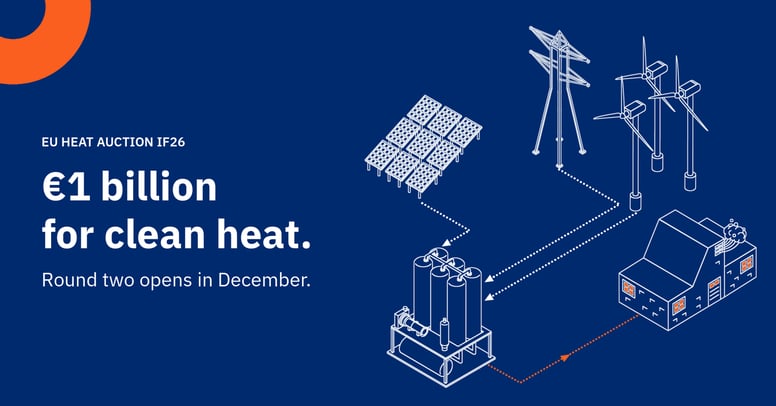
€1 billion for clean heat, round two: the EU Heat Auction reopens in December
The first EU Heat Auction for industrial heat is done. Of 85 bids, the European Commission picked 65 projects to share around €400 million, from pulp and paper and glass to food and beverage, textiles and pharmaceuticals. The final list of signed projects is due before the end of the year.
Round two is next. The IF26 Heat Auction puts another €1 billion on the table, paid for by the EU's carbon market. Bidding is expected to open in early December 2026 and close in February 2027. Winners are paid for every tonne of CO₂ they cut, for up to five years.
Three changes matter if you're looking at thermal storage:
- Storage is on the list. Thermal storage is now named as an eligible technology, alongside heat pumps and electric boilers.
- Flexibility pays. Projects with enough storage to cover at least 20% of their heat or power needs for four hours get a 25% head start in the ranking, and aren't held to the 70% load-hours limit that applies to others.
- More time to build. Projects get two and a half years to lock in financing and five years to start operating.
The money is there. The real question is whether your project will be ready when the window opens.
Heatcube delivers steam at 150–300°C, right in the auction's mid-temperature range (100–400°C). If you're thinking about a bid, talk to us before the window opens. We worked alongside industrial partners in round one and can help you build the technical case.

Inside Kyoto: Meet Celia, the filter between sales and engineering
Last month, Pablo passed the baton to the colleague who works the other end of the chain: convincing customers. Meet Celia Rodríguez Rivero, Technical Sales Engineering Manager in our Seville office.
Before Kyoto, Celia worked in operations in the food industry, on our customers' side of the table. Today she sits between our commercial and engineering teams, making sure what we sell is something we can build, and what we build is something customers want to buy:
"In a way, my job is to make sure that neither team gets everything they want, but the customer gets what they need."
Read why she spends so much time inside other people's factories, why sunny Spain still needs more than solar to run a factory, and who she passes the baton to next.

Welcome to the team, Marta!
Every company has that one person who quietly keeps everything running: the person everyone turns to, because they know things will get sorted. In Seville, that person is now Marta Alaminos, who has joined Kyoto as Office & People Operations Manager.
Marta will keep our office organised, make things happen behind the scenes and help our people do their best work. We're very glad to have her on board.
¡Bienvenida, Marta!
Pharma's new question for suppliers: how do you make your steam?
Steam runs through drug production, and most of it still comes from gas-fired boilers. That's the target of the Clean Heat Program, run by consultancy ERM and supply-chain network Secaro. AstraZeneca was the first founding member in December 2025, and Sanofi, UCB and Opella joined in September. The programme already covers more than 1,000 supplier sites, and all four companies have climate targets that also cover the emissions in their supply chains.
If you produce active ingredients or manufacture under contract for big pharma, that changes the conversation. Your biggest customers want to know how your steam is made, and they're offering technical help and, in some cases, financing to change it. Sooner or later the question lands on your desk. Better to have the answer ready.
What stands in the way
The programme lists the same hurdles we hear on site visits: too little in-house expertise, too little funding, and heat systems that are hard to upgrade in plants that can't stop. Opella's Chief Sustainability Officer told Trellis the hard part isn't finding lower-carbon technology. It's making it work across very different sites without compromising quality, safety and reliability.
Where the money could come from
Besides the programme's own incentives, the IF26 Heat Auction (see above) is open to every industrial sector, and pharmaceutical projects were among those selected in round one.
Why revalidation may be smaller than it looks
Plant steam from the boiler house doesn't touch the product. The steam that does, for example to sterilise equipment, comes from a separate clean steam generator, usually heated by plant steam through a heat exchanger. Swapping the source of plant steam still means change control and an impact assessment, but it's a very different job from changing the steam that touches the product.
That's where Heatcube comes in: steam at 150–300°C from stored electricity, fed into the steam system you already have.
Sources: Trellis, Secaro, ISPE
See how Heatcube works for pharma

Thank you, Drees & Sommer
On 5 November, our CCO Tim de Haas and Roger Wietusch, Commercial Manager DACH, joined Energy meets Industries 2026 at the 50Hertz headquarters in Berlin, a day about one question: how industry can change without the bill getting out of hand.
A big thank you to Drees & Sommer for bringing us together at Energy meets Industries 2026! We really enjoyed the lively exchange and appreciated the positive feedback during our BESS vs TES deep-dive session. Special thanks to Dierk Mutschler for challenging us all to step outside our comfort zones and enabling conversations across industries and stakeholder groups.
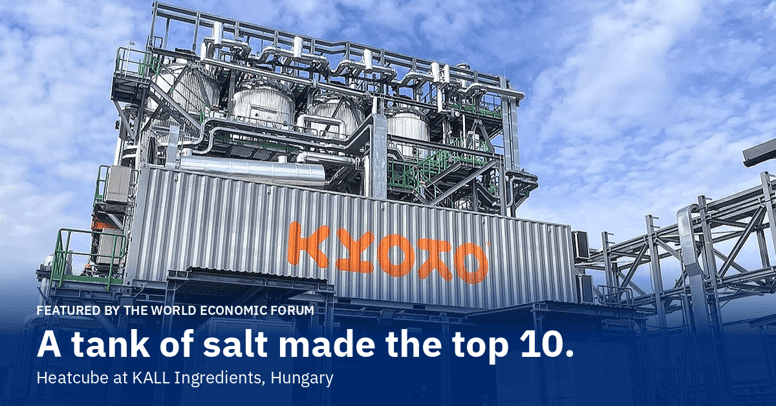
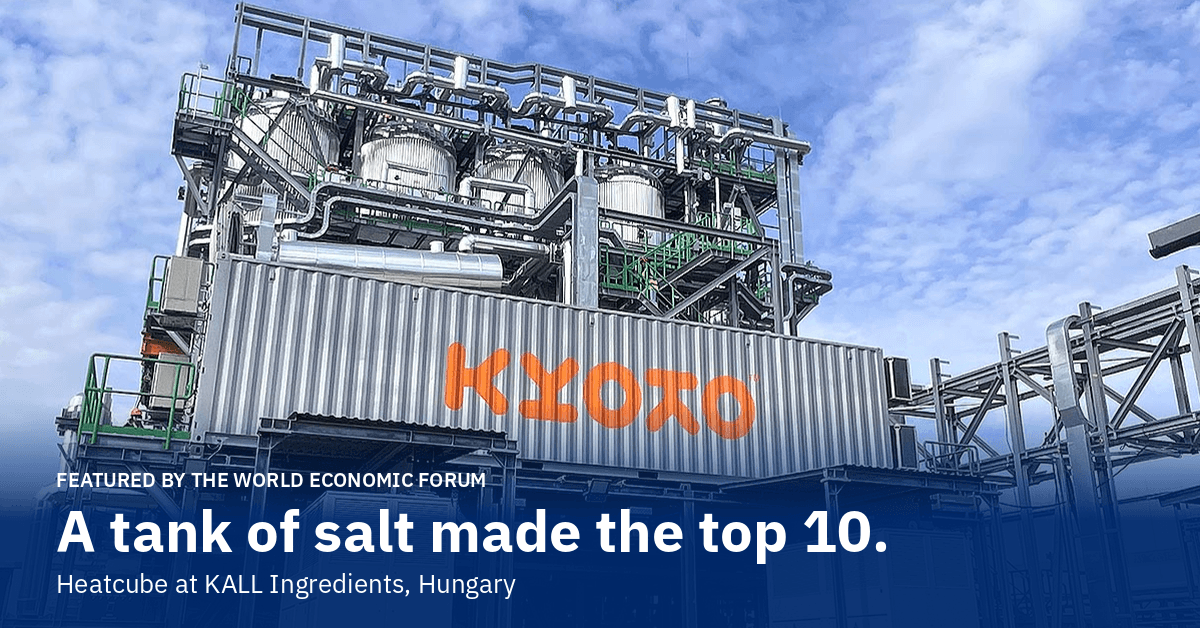
A tank of salt just made the World Economic Forum’s top 10
Floating offshore wind. Solar cells that beat silicon’s efficiency limit. Batteries made from sodium, zinc and iron. Cement with up to 40% lower emissions. And industrial heat batteries.
The World Economic Forum has picked 10 emerging technologies that could help countries cut emissions and reduce their exposure to energy shocks. The story opens at KALL Ingredients in Hungary, where a Heatcube turns cheap electricity into steam at a lower cost than gas.
For our CEO Morten Bülow, the point is that industry no longer has to choose between cutting emissions and keeping energy affordable. The Heatcube addresses both, he says. "If you can kill two birds with one stone, you also get higher security of supply.”
Morten also explains how charging at night helps the grid, and why the biggest barrier to change may be habit rather than technology.
Coming up next month: the baton has two candidates
Inside Kyoto has a twist. For the first time, the baton isn't passed to one colleague, but to two.
Both work alongside Celia in our Seville office, and both see the Heatcube from a very different angle than she does. One makes sure it does exactly what it's told. The other keeps projects on track, from the first drawing to the first steam.
Who's next? You'll meet the first of them in our December newsletter.
Stay tuned!